
Growing and processing almonds in California’s Great Central Valley is a seasonal business that comes to climax for a period of about 60 days in September and October. It is during this time when the nuts are harvested, graded and sorted. During the harvest season, the Assali family harvests almonds from their own fields and then takes them for cleaning, sorting, and grading so that they can be prepared for domestic and international distribution. During this same 60-day period, the Assali's also pre-sell as much as 40 percent of the crop and arrange international shipping primarily through the Port of Oakland.
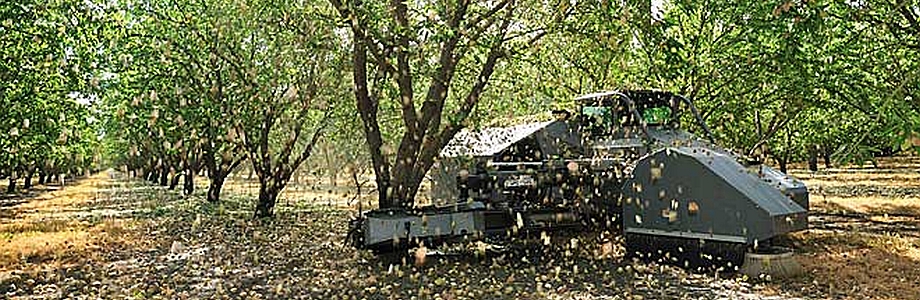
The harvesting process begins with shaking the almonds from the trees. Once shaken from the trees, the nuts dry on the ground for 1-2 weeks, then they're swept into windrows, picked up, and taken to a plant where they're hulled and shelled. The hulls, shells and other waste materials do not go to waste at all. Shells and hulls are turned into bedding for livestock, cattle feed, and plant mulch. For the shelled almonds, the last stop is the processing and packaging plant. Then it's onto the consumers.
Once the almond harvest is over, we turn our attention to post-harvest management practices including orchard sanitation, irrigation and dormant sprays all are critical to next year's nut quality and yield potential. The first thing we do is irrigate the trees after harvest. From the time harvest is finished until the trees lose their leaves, irrigation is extremely important. Pruning is another important management practice that should be completed soon after harvest. Additionally, the removal of mummies and stick-tight nuts is one of the most effective ways we have of controlling navel orangeworm. Larvae overwinter in mummies that remain on the tree after harvest. By removing mummies and destroying them during the winter, we can significantly reduce navel orangeworm infestations the following season. Finally dormant sprays are an integral component of a good winter management program. Dormant sprays are important to control pests such as peach twig borer and San Jose scale.
California produces all of the nation's commercially grown almonds. Estimated almond acreage from 2004 was 620,000 acres. Nonpareil is the leading variety followed by Carmel and Butte. Bearing acreage is 550,000 acres, 70,000 non-bearing acres. Kern, Merced, Stanislaus and Fresno are the leading counties.*
Assali Farms produces Nonpareil, Carmel, Monterey, Butte and Padre varieties.
*Statistics from the California Agricultural Statistics Service
2004 California Almond Acreage Report